Support

If you’re having problems with the platform, you can reach out to our IT support team through the live chat.

Skip to main content

About this Course

Navigating the complexities of tariffs and trade regulations in the international trade sector can be challenging. The Customs Tariff Essentials course is specifically designed to address these challenges. It provides an in-depth understanding of the fundamental concepts of tariffs, including their function, application, and role as trade barriers.

Is this course for you?

This course is for people who aspire to be involved in international trade, including importers, exporters, and customs officials. Importers and exporters will benefit from a clearer understanding of tariff classifications and policies, enabling them to make more informed decisions, ensure compliance, and optimize their trade strategies. For customs officials, the course provides essential knowledge for accurate tariff classification and application, ensuring effective regulation and facilitation of trade.

Whether you're looking to streamline your import/export operations or aiming to enhance your expertise in customs procedures, this course offers valuable insights and practical skills to handle the complexities of tariffs in the global trade environment.

What will you learn?

After the completion of this course, you will learn:

  • The fundamental concepts of tariff
  • An overview of Pakistan’s tariff policy and its impact on local & international trade
  • How to accurately categorize goods using the Harmonized System (HS)
  • How to utilize available resources to make informed classification decisions
  • The application of the Advance Ruling System in Pakistan
  • Time Duration 30 to 60 minutes
  • Difficulty level Beginner to Intermediary
  • Learning Mode 100% Online
  • Prerequisites None
  • Prerequisite Courses None
  • Language English
  • Self-Paced
  • Full Lifetime Access

Offered By

PSW

The Pakistan Single Window (PSW), an initiative led by Pakistan Customs, represents a significant leap forward in modernizing trade practices within the region. The primary objective of PSW is to streamline the complexities of cross-border trade, making it more efficient, cost-effective, and accessible. This goal is achieved by transitioning traditional, paper-based trade processes into a fully integrated digital system.

CIPE

The Center for International Private Enterprise (CIPE) was founded in 1983 by President Ronald Reagan. CIPE has been at the forefront of promoting democracy and economic freedom amidst global challenges. It focuses on strengthening democratic institutions to foster a conducive environment for business and entrepreneurship. Their enduring efforts are vital in addressing the evolving economic and social needs of citizens in democracies around the world.

SDPI

The Sustainable Development Policy Institute (SDPI) was established in 1992 in response to call for a dedicated entity to guide the nation’s socio-economic development within an environmental framework. It is a leading source of expertise and advisory in South Asia’s policy landscape, offering expertise and advisory services to the government, private sector, and non-governmental organizations.

Outline

Module 1: Tariffs: Fundamental Concepts

In this section, we will learn about what tariff is, what are its types and how it works. We will also learn the impact of tariff on global trade in the Pakistani context.

Show breakdown

Module 2: The Harmonized Commodity Description & Coding System

In this section you will learn about the importance of accurately identifying goods in trade, focusing on the widely used HS coding system. You'll learn about its organization, interpretation, and practical application in the global trade landscape.

Show breakdown

Module 3: Useful Tools & Procedures to Assist with Classification

In this section, you will learn about the complicated nature of identifying goods with examples, tools that assist with such classification and the Advance Ruling System of Pakistan that governs the interpretation and application of customs laws.

Show breakdown

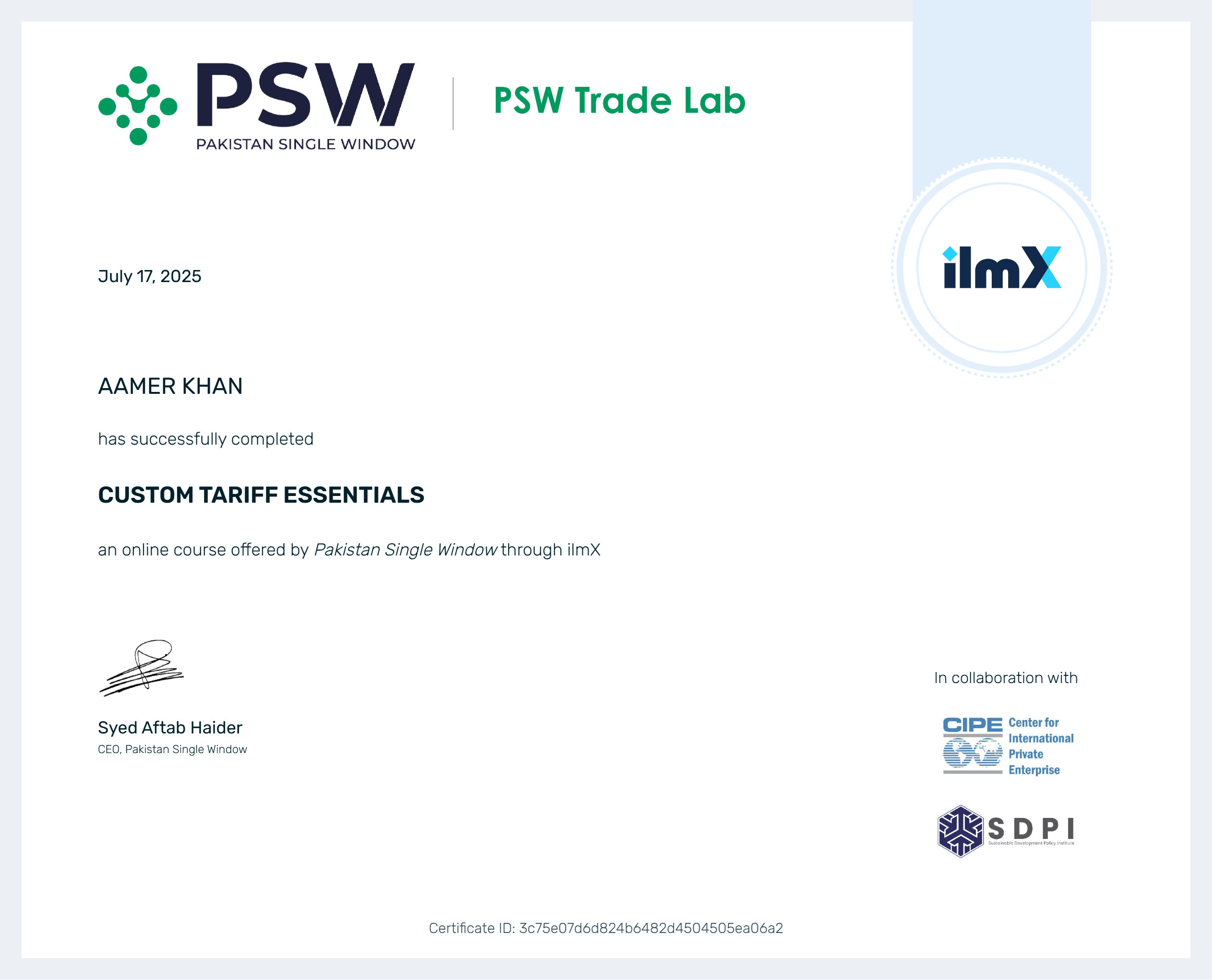
Shareable Certificate

Upon completion of the course, you receive a signed certificate from the institute. You can share this certificate in the certifications section of your LinkedIn profile, on printed resumes, CVs, or other documents.

PSW

Frequently Asked Questions (FAQs)

You should take this course if you want to experiment with student-centred teaching approaches, want to create an environment of collaborative and active learning in your classroom, and want to ensure that students are really internalising the concepts you are teaching.
You will have to watch all the videos, read the PDFs, and play all the games to complete the course.
Yes, you can take a test again. The score for the latest attempt will be recorded.
You do not have to complete the course in one go. There is a lot of information here, so you should learn at a pace that is comfortable for you. You can pause at any time, and return when it’s convenient for you to resume the course. You may also go back over a completed module to refresh your memory at any time.
The certificate is a certificate of completion. If you complete all the modules, then the certificate will be available to you at the end of the course. There is no minimum score required to pass the course.
For any issues feel free to reach out to us at support@ilmx.org.
The course should take you between 10 to 15 hours depending upon your reading speed. As this is a self-paced course, the exact time of completion depends on you.
Enroll